
Table of Contents
- What Same-Day Repair Service Actually Means
- The Difference Between Same-Day Arrival, Diagnosis, and Completed Repair
- How Long Do Phone Repairs Take and What Affects Speed
- Same-Day Computer Repair: When It's Realistic and When It Isn't
- Questions to Ask a Phone Repair Shop Before Booking Same-Day Service
- Phone Repair Privacy and Security: What Happens to Your Data
- Red Flags and Consumer Protections: Avoiding Repair Shop Scams
- Conclusion
- Frequently Asked Questions
Last Updated: October 13, 2026
What Same-Day Repair Service Actually Means
When a shop says "same-day service available," it's easy to assume your device will be fixed by evening. Not always.
Same-day repair service means the technician will arrive and diagnose your device the same day. It does NOT automatically mean your repair will be completed the same day.

Many shops blur the line between arrival and completion to sound faster than they are.
The promise is about availability and speed of diagnosis, not guaranteed completion, so you're not misled when your phone arrives at noon but isn't ready until morning.
The Difference Between Same-Day Arrival, Diagnosis, and Completed Repair
These three things happen at different speeds, and conflating them causes most frustration.
Completion is hardest to keep: parts availability, software complexity, and workload all affect whether a repair finishes today. A cracked screen on a common phone? Likely same-day.
The marketing term "same-day repair service" typically means arrival and diagnosis; completion depends on factors outside the shop's control. A reputable shop tells you upfront which category your repair falls into.
How Long Do Phone Repairs Take and What Affects Speed
Most phone repairs take 30 minutes to 2 hours of hands-on work. Total drop-off-to-pickup time depends on several factors.
Workload matters most. Three phones ahead of yours means waiting. A one-person operation like TonyV's Tech Repair schedules appointments rather than accepting peak-time walk-ins; bigger chains take on more devices than they can handle, creating backlogs.
Complexity of the repair determines how long the technician actually spends on your device:
- Screen replacement: 30-60 minutes
- Battery replacement: 15-30 minutes
- Software troubleshooting: 45 minutes to 2 hours
- Water damage assessment: 1-3 hours (sometimes requires drying time)
Parts availability is the hidden delay. In-stock parts mean a faster repair; ordered parts mean days, not hours.
Software updates and testing add 30-60 minutes: verifying the device works, running updates, and sometimes restoring your data.
Shops that deliver real same-day completion keep common parts in stock and limit daily appointments to what they can realistically finish.
Same-Day Computer Repair: When It's Realistic and When It Isn't
Computer repairs have a wider range of outcomes than phones, making same-day completion less predictable.
Realistic for same-day completion:
- Hard drive replacement or upgrade
- RAM installation
- Software issues (malware removal, operating system repairs)
- Overheating problems (cleaning, thermal paste replacement)
Unlikely for same-day completion:
- Motherboard failure (often requires replacement, which can take days to arrive)
- Liquid damage (requires extended drying and component replacement)
- Screen replacement on laptops (many models require disassembly of the entire device)
- Data recovery from failed drives (can take days or weeks)
The difference is parts and complexity: desktops use standardized components shops stock, while laptops vary by model, parts aren't always in stock, and disassembly takes longer. A laptop that won't turn on can be diagnosed same-day, but a fried motherboard may take 5-10 days to replace, that's laptop repair logistics, not the shop's speed.
Questions to Ask a Phone Repair Shop Before Booking Same-Day Service
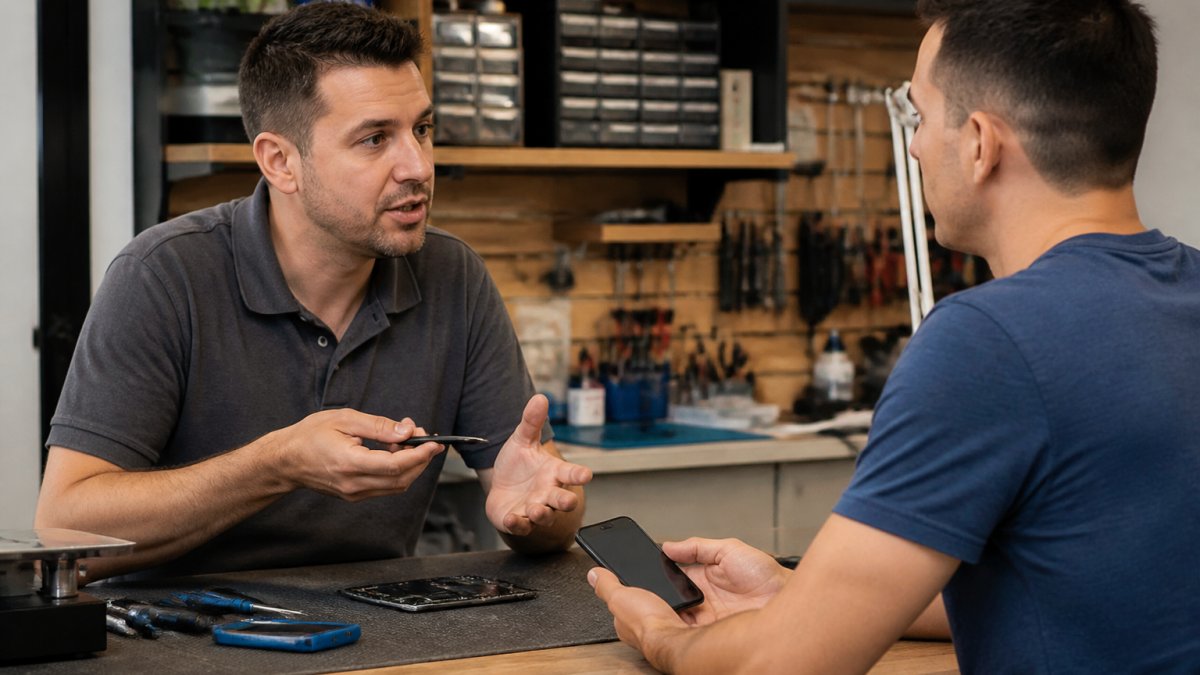
Before booking, ask these questions. They separate shops that deliver same-day service from those just marketing it.
**1.
**2.
**3.
4. "What happens if something goes wrong after you fix it?" Look for a warranty or guarantee, even if it's just 30 days.
**5.
6. "Will you explain what's wrong in plain language, or will you use technical jargon?" If they can't explain it simply, find another shop.
The Money Questions Most Shops Hope You Won't Ask
The questions above get you a working device; these get you a fair price.
**7.
**8.
**9.
10. "If the repair fails or the part is defective, do I pay again?" A warranty covering parts but not labor (or vice versa) leaves you exposed.
11. "What forms of payment do you accept, and do you take a deposit?" Legitimate shops take credit cards, which gives you chargeback protection.
How Repair Pricing Actually Breaks Down
Repair pricing is a stack of line items you can ask about before committing.
- Diagnostic or bench fee, charged to open the device and identify the fault. Often $25-$75 at independent shops, sometimes waived if you approve the repair.
- Parts, the largest variable. OEM parts cost more than aftermarket, and rare models cost more than common ones. Ask whether the part is OEM, OEM-equivalent, or aftermarket.
- Labor, usually quoted as a flat rate per job type (screen, battery, charging port) rather than hourly.
- Dispatch or mobile-service fee, added when the technician comes to you instead of you going to the shop.
Prices vary by region, device model, and shop size, so don't memorize a price list, just make the shop itemize before you hand over the device.
These questions take 5-10 minutes on the phone and save you from booking with a shop that can't deliver, or paying twice what the repair was worth.
Phone Repair Privacy and Security: What Happens to Your Data
Handing over your phone for repair means handing over access to your personal data. Know what protections exist.
What the technician can see: Depending on the repair, they may access your file system, photos, messages, or contacts.
What you should do before dropping off your device:
- Back up critical data yourself (use cloud storage or a computer)
- Remove sensitive information if possible (delete photos, clear browser history, sign out of accounts)
- Ask the shop what they'll need to access and why
- Request that they avoid accessing anything unrelated to the repair
What protections exist: Most states have no specific laws protecting customer data during repair.
TonyV's Tech Repair treats customer privacy as non-negotiable: we access only what's necessary and don't retain copies of your data.
Red Flags and Consumer Protections: Avoiding Repair Shop Scams
Not every repair shop is honest. Knowing the warning signs keeps you from getting overcharged or having unnecessary work done.
Major red flags:
- Shop diagnoses a problem without looking at your device first
- They pressure you to decide immediately without explaining options
- They refuse to show you the broken part or explain what was replaced
- They charge for diagnostics but won't credit it if you don't repair with them
Honest shops:
- Explain the problem in plain language
- Show you the broken part
- Give you a written estimate before starting work
- Offer options (repair now, repair later, replace device)
Consumer protections that exist:
- Many states require written estimates for repairs over a certain amount
- Shops must return your original parts on request
- You can refuse a repair after diagnosis
- Warranty laws vary, but most require shops to stand behind their work for a reasonable period
If a shop won't give a written estimate or refuses to return your broken parts, walk away. Those aren't industry quirks, they're signs the shop is hiding something.
Repair or Replace? A Framework for the Decision
Once you have a written estimate, the next question is whether the repair is worth doing at all.
Step 2: Factor in the age of the device.
- Under 1 year: repair is almost always the right answer, especially if the device is still under manufacturer warranty (check whether the repair voids it).
- 1-3 years: repair usually wins unless the repair cost approaches replacement cost.
- 3-5 years: repair and replace are roughly even. Consider whether the device still meets your needs.
- Over 5 years: replacement is usually the better investment, because other components are likely to fail soon after the repaired one.
Step 3: Check warranty status. If the device is under an active manufacturer warranty or protection plan, contact the manufacturer or administrator before authorizing third-party repair.
Step 4: Weigh safety and data.
- Devices with swollen or punctured batteries, burn marks, or water exposure should be assessed by a professional before you power them on again. Safety concerns override cost math.
- If the device holds irreplaceable data, data recovery may be worth more than the hardware itself, and that changes the calculation.
Step 5: Consider resale and trade-in value. A repaired device usually holds more resale value than a broken one, but third-party screens or batteries can lower trade-in value.
What to Do If You Think You've Been Scammed
If a shop charged for work it didn't do, kept your device without authorization, or refused to return your parts, you have options:
- Dispute the charge with your credit card issuer. Fastest path if you paid by card, and why paying by card matters.
- File a complaint with your state attorney general's office. Most states have a consumer protection division for repair fraud.
- File with the Federal Trade Commission at ReportFraud.ftc.gov. The FTC doesn't resolve individual disputes but builds cases against patterns of fraud.
- File in small claims court if the amount is within your state's limit (usually thousands of dollars, no lawyer needed).
- Leave a factual review. Reviews are the most effective pressure point on a local shop and help the next customer avoid the same problem.
Keep your written estimate, receipt, and any texts or emails with the shop, those documents make a dispute winnable.
Conclusion
Same-day repair service is real, but it means something different than most people think: a promise about diagnosis speed and technician availability, not guaranteed completion. Understanding that keeps you from booking with unrealistic expectations.
Before you book, ask specific questions about parts availability, wait times, and what happens if the repair can't finish today. For most device issues, we can get you answers and a repair timeline the same day you call. Book a Service and get your device working again without the runaround.
Frequently Asked Questions
Is same-day repair service actually real?
Same-day repair service is real, but it depends on what you mean by 'repair.' Most repair shops can get you an appointment the same day and diagnose your device quickly. However, completing the full repair same-day depends on parts availability, the complexity of the issue, and current workload. A simple software fix or battery replacement often completes same-day. A motherboard repair or custom part order typically doesn't. Ask your repair shop upfront whether they mean same-day arrival, same-day diagnosis, or same-day completion before booking.
What repairs can usually be completed the same day?
Software issues, password resets, malware removal, battery replacements, screen protector installation, and basic troubleshooting usually complete same-day because they don't require parts inventory or complex labor. Hardware repairs like screen replacement, charging port repair, or logic board work can complete same-day if the technician has the replacement parts in stock. Parts that must be ordered, such as specialized components for older devices, require a follow-up visit. Always confirm parts availability when you book to avoid disappointment.
How long do phone repairs take, and what can delay them?
Simple phone repairs take 30 minutes to 2 hours. Diagnostics alone typically take 15-30 minutes. Delays happen when the repair shop is backlogged with other appointments, replacement parts aren't in stock, the issue is more complex than initially diagnosed, or the device needs software updates before repair. Calling during slower business hours, typically mid-morning or mid-week, improves your chances of faster service. Always ask about current workload and parts availability when you schedule.
What should I ask a repair shop before booking same-day service?
Ask: (1) Do you have this replacement part in stock? (2) How long is your current wait time? (3) Do you charge for diagnostics? (4) What's your warranty on the repair? (5) If you can't fix it same-day, what's the next step? (6) How do you handle my personal data during repair? (7) What payment methods do you accept? These questions prevent surprises and help you understand whether same-day completion is realistic for your specific device and issue.